
1,000
Multi-year, phased implementation conditioned on technical, budgetary and performance criteria.
National Network of Integrated Centres for Security, Training and Citizenship
A national network of regional centres for continued capacity building, humanised training, data governance and transparency technology in support of Brazil’s Unified Public Security System (SUSP).
Request by Federal Deputy Delegado da Cunha before the Chamber of Deputies Public Security and Organised Crime Combating Committee, honouring Col. RR Leonardo José Rodrigues de Sant’Anna for conceiving and developing CISTeC, currently executed by the Brazilian Ethics Association — AEB.
Filed 10 Jul 2026 · CSPCCO · Chamber of Deputies
PDF · 3 pages · Portuguese · PDF · electronically signed · Portuguese
The CISTeC National Security Project proposes the multi-year implementation of up to 1,000 regional training units, organised into 28 Federative Hubs (the 27 states and the Federal District). Physical infrastructure is a means of execution: the core of the proposal is a permanent architecture of technical support for continued training, standardised procedures, evidence management, accountability and results evaluation in public security.
Multi-year, phased implementation conditioned on technical, budgetary and performance criteria.
The 27 states and the Federal District, serving smaller municipalities by area of influence.
Filing ceiling of R$ 4.9 billion, with calculation memory, scenarios and sustainability assumptions.
Governance, infrastructure, operation and maintenance, humanised training and transparency technology.
A national network of regional centres for continued capacity building, humanised training, data governance and transparency technology in support of Brazil’s Unified Public Security System (SUSP).
Committees, adhesion agreements, RACI matrix, hub-municipality selection criteria, integrity plan and compliance dossier.
Units by typology (Standard, Full and Premium) with designs, SINAPI-referenced budgets, engineering liability records, works diary, measurements and acceptance terms.
Active units with preventive and corrective maintenance, service orders, monthly reports, photographic evidence and availability targets.
Curriculum aligned with Decree 12,341/2024 and the National Curriculum Matrix/Senasp, emphasising progressive use of force, de-escalation, conflict mediation, human rights and officers’ mental health.
Public portal, API, dashboards, documentary trail, digital evidence, quarterly reports, independent audit and result indicators.
The system behind CISTeC was designed to give public authorities real-time visibility of each unit: documents, materials, photos and biweekly georeferenced records let the granting body follow construction, delivery, maintenance and the training programmes under way from the first built units onwards. The technology component, of R$ 38 million, is treated as critical infrastructure of the project.
Per-unit pages, executive dashboards, open data in aggregated form and documented public endpoints for social control and audit.
Construction photos and records with location, date, user and per-unit linkage, covering partial acceptance, full acceptance and formative use.
Works diary, measurement bulletins, engineering records, contracts, invoices, reconciliations and reports published with versioning and logs.
Service orders, roving-supervision tickets, monthly maintenance reports and operational availability targets per unit.
Teaching platform with classes, attendance, evaluation, certification and reports — training starts at the first delivered units.
Segregated profiles, encryption, audit trail and publication of aggregated data only, without exposure of sensitive information.
Living roadmap: this section will be updated as execution evolves, with verifiable monthly milestones, published indicators and evidence for each phase.
Updated June 2026
AEB institutional dossier, normative matrix, budget, governance, indicators and territorial criteria for filing with the Ministry of Justice.
In progressValidation of engineering, costs, training, maintenance, technology and governance in pilot unit(s) with a positive audit.
PlannedImplementation in high-priority hub municipalities, with federative agreements, secured budget and validated land matrix.
PlannedExpansion to intermediate hubs and strategic areas, conditioned on pilot results and operational sustainability.
PlannedMaximum agreed scale, with external control without critical reservations, funded maintenance and fulfilled indicators.
PlannedPermanent governance foresees a National Permanent Core with 50 functional members, segregation of duties, approval thresholds, RACI matrix, integrity committee, whistleblowing channel, data protection, independent audit and periodic accountability — with the CPE as the highest executive role and a dedicated internal controller.
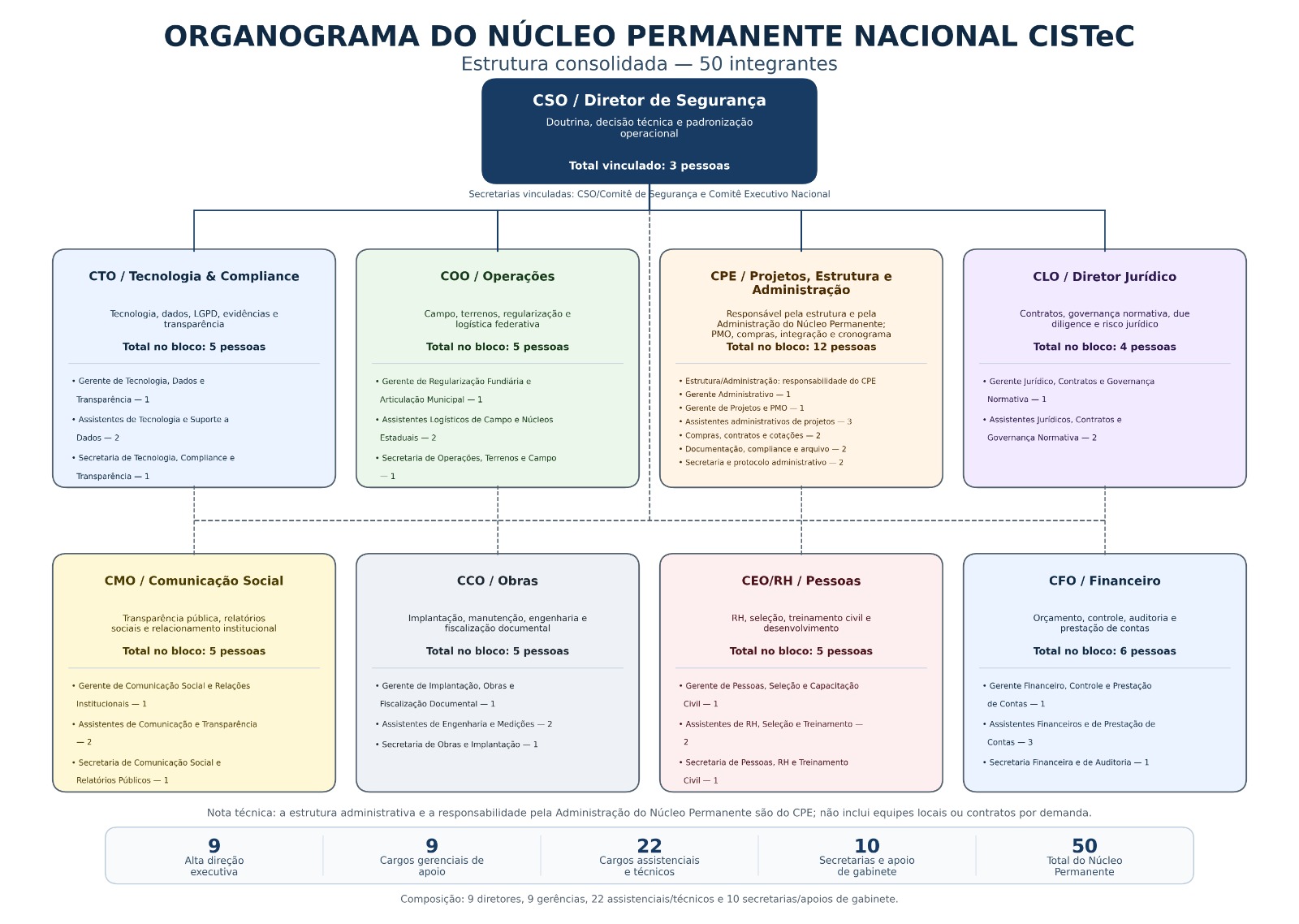
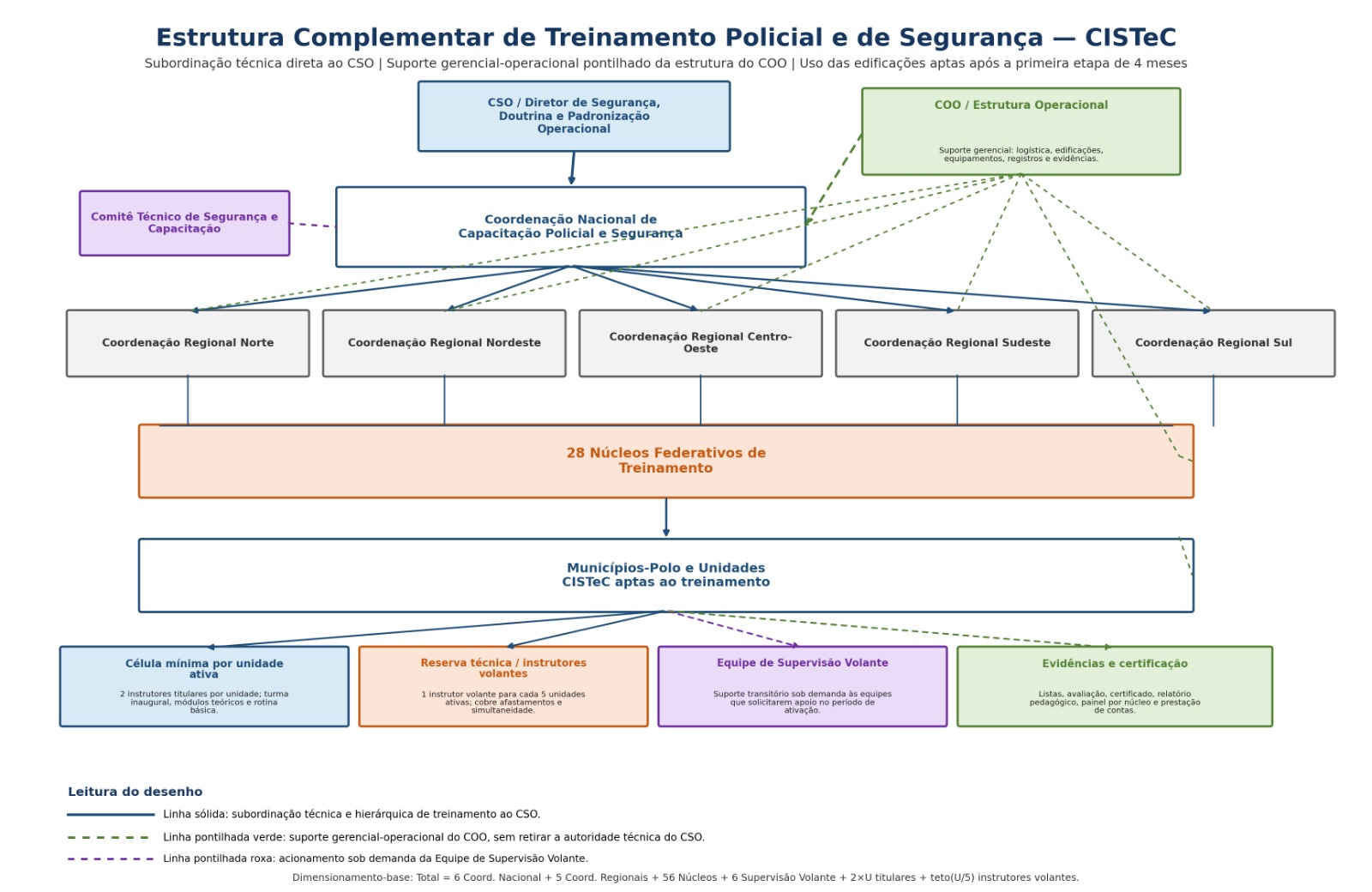
Versions published for institutional transparency. The dossier may receive minor adjustments until filing with the Ministry of Justice.
PDF · 3 pages · 10 Jul 2026 · Portuguese · Open document
PDF · electronically signed · 10 Jul 2026 · Portuguese · Open document
PDF · 40 pages · 12 Jun 2026 · Open document
PDF · 18 pages · 09 Jun 2026 · Open document
XLSX · final v5.0 revision · 12 Jun 2026 · Open document
PDF · 2 pages · Open document
PDF · reference executive design · Open document
PDF · 8 pages · v5.0 · Open document
CISTeC consolidates AEB’s historical humanised-security front, based on the executive models of Col. Leonardo Sant’Anna and the TFI institutional reference, preserving the Social Aggressor Approach and Personal Protection in Buildings course as a training instrument.
See the front’s historical recordPublic bodies, police academies, municipal guards and technical partners can engage with AEB about agreements, training and federative cooperation in an institutional environment.
Talk about CISTeC